

Changes at the Central Bank
One of the factors that significantly influenced the metal’s performance in recent days was the first meeting of the U.S. Federal Reserve under the leadership of its new Chair, Kevin Warsh. During its June meeting, the central bank kept interest rates unchanged at 3.5% to 3.75%, a decision that had been widely expected. However, investors were more interested in the bank’s forecasts and communication tone. While Fed officials had still been considering the possibility of rate cuts in the spring, the June projections were notably more cautious. The median expectation among committee members moved to 3.8% by the end of 2026, which according to CNBC suggests that another rate increase remains a possibility. The Fed also raised its inflation forecast for this year to 3.6%, significantly above the 2.7% projected in March. Core inflation forecasts also increased.[1] Warsh, who took over the leadership of the central bank in May this year, replacing Jerome Powell, also indicated plans to reassess the way the Fed communicates its decisions. Following the meeting, he presented a considerably shorter statement that omitted language suggesting future policy easing, demonstrating that the fight against inflation remains a priority for the U.S. central bank.
The Conflict Brought an Unusual Reaction
After the outbreak of the conflict in the Middle East, many investors expected gold to be among the main beneficiaries of rising uncertainty, as history has shown that capital often flows into safe-haven assets during periods of turmoil. However, recent developments brought a surprise. Since the beginning of the conflict at the end of February, the price of gold weakened by tens of percent instead of continuing its upward trend.* At first glance, it might appear that the yellow metal failed in its role as a safe haven, but the explanation is simpler. According to Forbes, analysts note that during crises gold also serves as a source of readily available liquidity, and part of gold reserves may become one of the first assets to be sold. As restrictions on shipping in the Persian Gulf reduced the flow of money into economies, lower dollar liquidity put pressure on existing reserves, including gold. The decline in price therefore does not necessarily indicate a loss of investor confidence in the precious metal, but rather demonstrates that gold can serve multiple purposes at the same time.
From the Peak to a Correction
A closer look at gold prices shows that the spot price followed an upward trend over the past five years until January 27, 2026, when it reached an all-time high of USD 5,400. Although gold experienced a correction during this period, it managed to climb back above USD 5,300 until the beginning of the aforementioned conflict, after which its price declined by more than 22% to current levels. As of June 24, 2026, the precious metal was trading at USD 4,057. While gold has experienced a decline over the past few months from a short-term perspective, it remains firmly in positive territory over the long term. Over the past year, its price has remained 22% higher, while over the last five years it has increased by more than 128%. Futures contracts followed a very similar path to spot gold, with prices fluctuating around USD 4,079 at the end of June.*
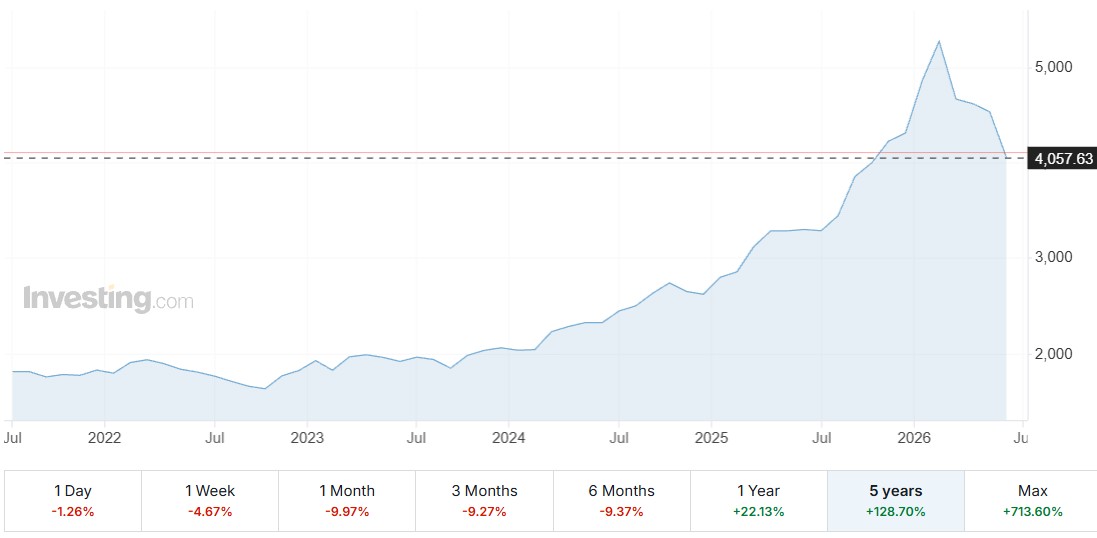
Development of spot gold prices over the past five years. Source: investing.com*
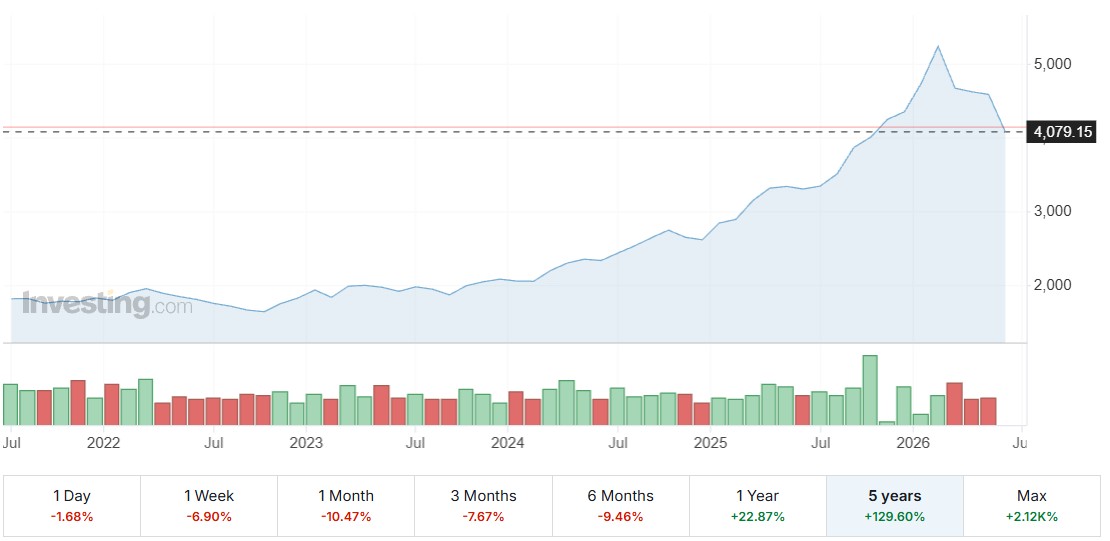
Development of gold futures prices over the past five years. Source: investing.com*
Continued Reserve Building
Short-term price fluctuations do not change one of the most significant trends of recent years. That trend is the growing interest of central banks in gold, which according to the World Gold Council (WGC) is unlikely to change significantly in the coming period. A survey covering 74 central banks showed that an overwhelming majority expect gold reserves to increase over the next year, while 45% anticipate increasing their own gold holdings. Over the past four years, central banks have purchased around 1,000 tonnes of gold annually, double the average seen during the previous decade. This pace of buying is expected to continue. The proportion of institutions that have repatriated gold reserves or diversified storage locations abroad has also increased, a trend that experts attribute largely to geopolitical developments. In addition, gold carries strong symbolic value for many countries as a national asset. France, for example, is not changing its overall exposure but is adjusting the geographical distribution of its reserves through transfers between jurisdictions.
Bank Forecasts Have Changed Slightly
A summary of forecasts from several major banks shows significant differences, although they all share an expectation of continued growth in the price of gold. Year-end projections range from USD 4,900 according to Goldman Sachs to USD 6,000 in the case of JP Morgan. Even more optimistic forecasts were published by Bank of America and Wells Fargo, both expecting prices above USD 6,000. Goldman Sachs, for example, lowered its forecast from the previous USD 5,400, citing weaker inflows into gold-backed ETFs and interest rate developments. UBS also reduced its estimate to USD 5,500, while Morgan Stanley remains more cautious with a target of USD 5,200. According to these banks, future gains should be driven primarily by central bank purchases, the process of de-dollarization, and concerns regarding economic developments. Some institutions also noted that the recent decline appears to be a correction following a strong rally rather than the beginning of a longer-term reversal. Forecasts for 2027 continue to anticipate an ongoing growth cycle. [2]
* Past performance is not a guarantee of future results.
[1, 2] Forward-looking statements are based on assumptions and current expectations that may prove inaccurate, or on the current economic environment, which may change. Such statements are not guarantees of future performance. They involve risks and other uncertainties that are difficult to predict. Actual results may differ materially from those expressed or implied in any forward-looking statements.
This text constitutes a marketing communication. It does not represent investment advice, investment research, or an offer to enter into any transaction involving a financial instrument. The content does not take into account the individual circumstances, experience, or financial situation of readers. Past performance is not a guarantee or prediction of future results.



.svg)
.svg)